
A first order system of equations is any that can be put into a form like this:
 (Or maybe more equations)
Example from Chemistry
An example of a chemical reaction that leads to a system of three equations is given here:
Substance A is breaking down into substance B, which is also breaking down into substance C which is a stable element as this diagram depicts:

Each of these reactions obey the usual model A’=-kA, that is, the rate of change of the substance A is proportional to the present amount of A. Note the fact that A is decaying hence the negative sign. This reaction easily leads to the following system:
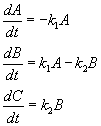
The middle equation says that the change in the amount of substance B is
equal to the amount of A that decays into B less the amount of B that decays
into C. The other two should be easily understood if you get this one. You
already know enough to solve this, and you’ll get a chance to do so
in the homework. 
Example of mixing
Here’s another problem involving mixture of saltwater in two tanks. A tank A has an inlet pipe flowing at three gal/min and an outlet pipe filling tank B at four gal/min. There is also a pipe flowing from tank B back to A at one gal/min. The diagram will make this clear, I hope. Let’s assume both tanks are 50 gallon, and tank A contains 25 lbs. of salt initially, and tank B contains no salt initially. Further assume that pure water is entering tank A at left at three gallons per minute.
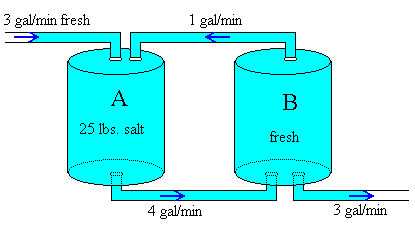
Let x(t) represent the lbs. of salt in tank A t minutes after fresh water flows in, and y(t) represent the lbs. of salt in tank B. Those functions can be found by solving the system of equations:
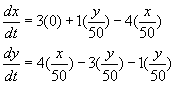
The positive coefficients represent salt coming in, the negative salt going out. The system simplifies to this one with given IC:
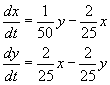 With x(0)=25, y(0)=0
Example of Predator-Prey
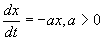
Here’s an example of what’s called a ‘Predator-Prey’ model, which helps explain the ‘balance of nature’. Let’s assume we are tracking two populations, predators (foxes) and prey (rabbits). Let x(t)=number of foxes at time t, y(t)=number of rabbits at time t. With no food, the fox population would decline according to the model
 .
.
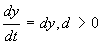
With assumed unlimited food resources, the rabbit population will grow according to the model
 .
.
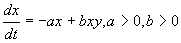
In addition to the natural decline of foxes, the fox population growth will be growing jointly proportional to the number of rabbits and foxes present. This changes the model for foxes into
 .
.
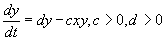
The rabbit model is also modified by the presence of foxes. There is a decline of rabbits in joint proportion to the amount of rabbits and foxes present. This model is now
 .
.
Therefore we have the following system of equations whose solution will track both populations:
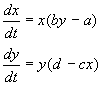
This is called the Lotka-Volterra predator-prey model and cannot be solved for elementary functions x and y but can be solved (but the solution will be a table of values) using numerical methods. Here is a graph of the behavior of two such functions x and y:
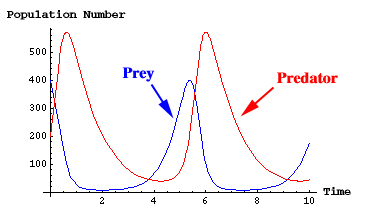
With spikes of this size, it is likely that the prey isn’t measured in the same units as the predators, i.e. prey 1=1000, predator 1=1 or something similar. You can see how a spike in the prey causes a spike in the predator, which in turn depletes the prey population, therefore reducing the predators, and the whole cycle begins again. Here's another link to predation information.
Species Competition
Suppose there are two species that do not eat each other, but do both share the same prey. An example of this might be foxes and coyotes, or bobcats and lynx.
Let’s assume that both grow according to the exponential growth
model .
.
Note that the presence of a competitor will have a negative impact on the growth of the competition. Let x(t) be the fox population and y(t) be coyotes. You can see where the system:

would be a reasonable model. If we make the assumption that each species grows logistically (See Unit II Lesson 2) then the populations grow according to
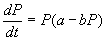
while still shrinking from competition, and the system becomes more complex:
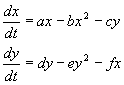
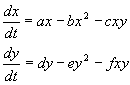
It might also be reasonable to claim that the growth rate of one species doesn’t retard the other unless they interact in some way, so the rate is retarded proportionally to the number of interactions xy, not the number of competitors, and the model becomes:
Solution of systems like this and those above is beyond the intent of this
course. The intent here is to get the ‘flavor’ of modeling.
Example of Electrical Networks
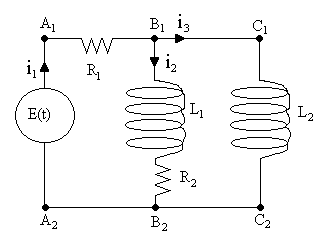
An electrical network having more than one loop gives rise to simultaneous differential equations. According to Kirchhoff’s first law, when a current is split, the total current going into a junction is equal to the total coming out. Here's a link to a demo of this law. Looking at this figure, the current i1(t) splits at B1, a branch point of the network. According to Kirchhoff’s law we can write:
i1(t) =i2(t)+i3(t)
According to Kirchhoff’s second law, the sum of the voltages in a complete circuit is equal to zero, or the electromotive force across a circuit is equal to the sum of the voltage drops across the circuit. Examining loop A1B1B2A2A1 we get
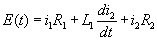
Also the other loop in this circuit, A1B1C1C2B2A2A1 we get:
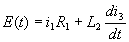
Substituting for i1 from i1(t) =i2(t)+i3(t) we get the system:
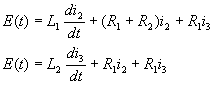
with two unknown functions i2 and i3.

Hand in this Project : (typed! word, works, mathcad, .pdf formats all are acceptable)
Construct your own Differential Equation or system of differential equations that is a model of some real world phenomenon. You don't have to solve it, and you can use the Internet, your text, or any library as a resource. You can, if you must, mimic any of the models in this lesson. Look at this website for some ideas.