Unit III Lesson 7
Modeling With
Linear Equations: Initial-Value Problems
Derivation of second order equations as models of motion on a spring (vibratory motion). 
Free undamped motion on a spring makes a sine wave describing its position at time t.
An example of free undamped motion as an initial value problem.
What if there is a damping force, and what if there is an external force added: The model changes.
An example of damped motion as an IVP with initial conditions.
Application to electronics, in particular an LRC circuit, and fumbling around with units...
An example of an IVP that is an LRC circuit.
There are examples of dynamic linear systems arising in the physical world
that lead to a 2nd order linear DE Ay’’+By’+Cy=g(t).
One of these is ‘free motion’ of a spring or any vibrating object.
Free Undamped Motion (Oscillatory Motion)


Consider a mass m suspended on a spring from a fixed vertical support. Let
L0 be the natural length of the spring. When a weight is hung
on the spring, it extends the spring an additional amount L, where it rests
in equilibrium position. According to
Hooke’s
Law, the tension on the spring is directly proportional to this extension
(F=kL) and this force would be the same as the weight of the object added
m*g. Therefore kL=mg for m=the mass of the object and g=the gravitation constant.
Now suppose at some fixed time t0, the mass is displaced
y0 units from its equilibrium position. If y=y(t) is the distance
of the mass from equilibrium at time t, then the extension at time t would
be L+y(t). Note that downward direction is usually considered to be positive.
According to one of Newton’s laws of mechanics, the rate of change of
downward momentum=the net downward force, in math symbols:
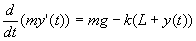
Noting the derivative of y’(t) is y’’(t) and that mg=kL this
will simplify to:

You should already know how to produce the general solution:

If the system is set into motion at time t0 by a displacement
y0 units and given an initial velocity v0, we have
the initial conditions y(t0)=y0 and
y’(t0)=v0. The whole problem is now a second order
linear IVP with constant coefficients.
This is an example of what is called free ‘undamped’ motion. This
motion will go on with no change unless something occurs to alter it. An
example in animated form, look at the following. (This animation was made
by a Russian scientific group. Their site can be viewed at this
link.)

Note that the graph showing its position appears to be a regular sine wave
with a fixed amplitude. That amplitude is not obvious from our solution,
but a little work with trig can produce it. If we start with a function of
form Bcos(wx)+Csin(wx), note that this can be expressed
A(B/A)cos(wx)+A(C/A)sin(wx).
In particular, let
A2=B2+C2. Let z be an angle whose sine is
B/A and whose cosine is C/A (i.e. tan(z)=B/C). Now we can write the function
as
Asin(z)cos(wx)+Acos(z)sin(wx)=A(sin(z)cos(wx)+cos(z)sin(wx))
Which can be written (lookup the sin(A+B) identity):
Asin(wx+z)
Therefore our solution  can be written
as
can be written
as

where 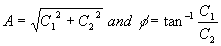 .
.
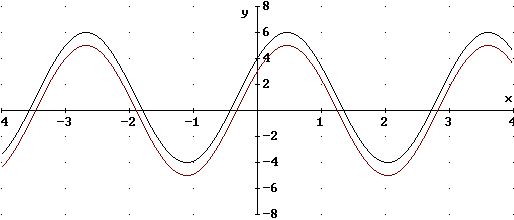
If you’d like to see this change, try comparing the graph of
y=3cos(2x)+4sin(2x) with the graph of y=5sin(2x+tan-1(3/4)) or
better yet so you can see the difference compare y=3cos(2x)+4sin(2x) and
y=5sin(2x+tan-1(3/4))+1.
This graph was made with 'Derive' of the functions:
y=3cos(2x)+4sin(2x) and
y=5sin(2x+tan-1(3/4))+1. Note one is just 1 unit
above the other.
Ex1. A 32 lb weight stretches a spring 2 feet. Determine
the amplitude and period of motion if the weight is released 1 foot above
equilibrium position with an initial upward velocity of 2ft/sec. How many
complete vibrations will the weight have completed at the end of
 seconds?
Take this link after you’ve tried it yourself.
Damping and external force
Such a concept as free undamped motion is not realistic, although it appears
in some applications. A more realistic approach would be to consider that
there is a damping force acting on the weight that is proportional to its
velocity at any given time. You see, there will be friction with the
surrounding medium that slows it down, or maybe the system itself has a damping
mechanical device. Think of the shock absorbers on your car. The springs
don’t continually bounce up and down after you go over a bump since
the ‘shocks’ act to dampen the bouncing. In either case the
"Proportional to velocity" adds to the differential equation and it becomes:
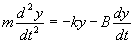 for some positive constant B.
There could also be an external force f(t) acting on the weight. Perhaps
the spring support is moving, or the weight could be attached to another
moving system. In that case another force is added and the DE becomes the
one we’ve been studying:
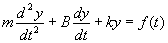
The solution to this equation will give the displacement y(t) of the weight
from its equilibrium position at time t and the initial conditions are
y(t0)=y0 representing the initial position of the weight
and y’(t0)=v0 representing its initial velocity.
If you want to experiment with this equation for various values of m, B and
k, visit this
website from the US military academy.
Ex2. A 4 foot spring measures 8 feet long after an 8 lb.
weight is attached to it. The medium through which it moves offers a resistance
numerically equal to
 times the
instantaneous velocity. Find the equation of motion if the weight is released
from the equilibrium position with a downward velocity of 5 ft/sec. Find
the time at which the weight attains its extreme displacement from the
equilibrium position.
times the
instantaneous velocity. Find the equation of motion if the weight is released
from the equilibrium position with a downward velocity of 5 ft/sec. Find
the time at which the weight attains its extreme displacement from the
equilibrium position.
Take this link after trying it yourself.
Electrical Circuits (LRC type)
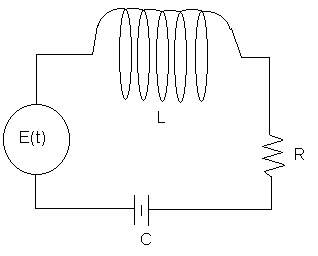
If we denote the current in the circuit by i(t)and the charge on the capacitor
as q(t) at time t, and L, R and C are inductance, resistance and capacitance,
then according to Kirchoff’s Second Law, The impressed voltage E(t)
on a closed loop must equal the sum of the voltage drops across the loop.
Also since i(t) is related to charge on a capacitor by i(t)=dq/dt we have
the second order linear DE:
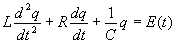
Each of the voltage drops on the left are from the circuit and constants
given:
Inductor =
Resistor =iR = R
Capacitor=
The solution q(t) will give the charge on the capacitor at time t.
An alternate form is to differentiate both sides
of
and get the equation: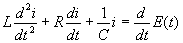 .
.
Ex3. Find the charge on the capacitor and the current in
the given LRC series circuit. Find the maximum charge on the capacitor.

Note h = henrys,
 =ohms, f
= farads, C = coulombs, A = amperes, V = volts.
=ohms, f
= farads, C = coulombs, A = amperes, V = volts.
Take this link after trying to solve it yourself.
****Assignment****
Chapter 5 Section 1
Problems1,3,5,21,45