Ex3. Find the charge on the capacitor and the current in the given LRC series
circuit. Find the maximum charge on the capacitor.
Note h=henrys,
 =ohms, f=farads,
C=coulombs, A=amperes, V=volts.
=ohms, f=farads,
C=coulombs, A=amperes, V=volts.
Solution:
The equation is 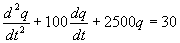 . The characteristic
equation of the homogeneous DE has –50 as a double root. The general
solution of the homogeneous equation is
. The characteristic
equation of the homogeneous DE has –50 as a double root. The general
solution of the homogeneous equation is

Using undetermined coefficients, we could assume a particular solution to
be of constant form A, and A would have first and second derivative both
zero, hence A=30/2500 or A=.012
The general solution to the non-homogeneous equation is

The initial conditions q(0)=0 and q’(0)=2 produce the values for C1 and C2 but first we need q’(t):

Substituting our IC gives the system of equations
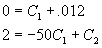
from which we obtain C1=-.012 and C2=1.4.
The solution to the IVP is:
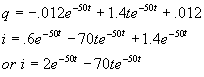
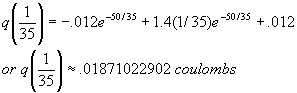
The maximum charge on the capacitor will occur when i=q’=0, and solving i=0 we get t=1/35. The maximum charge on the capacitor occurs when t=1/35, so we find the charge by finding q(1/35).